Connecting globally with human ecology
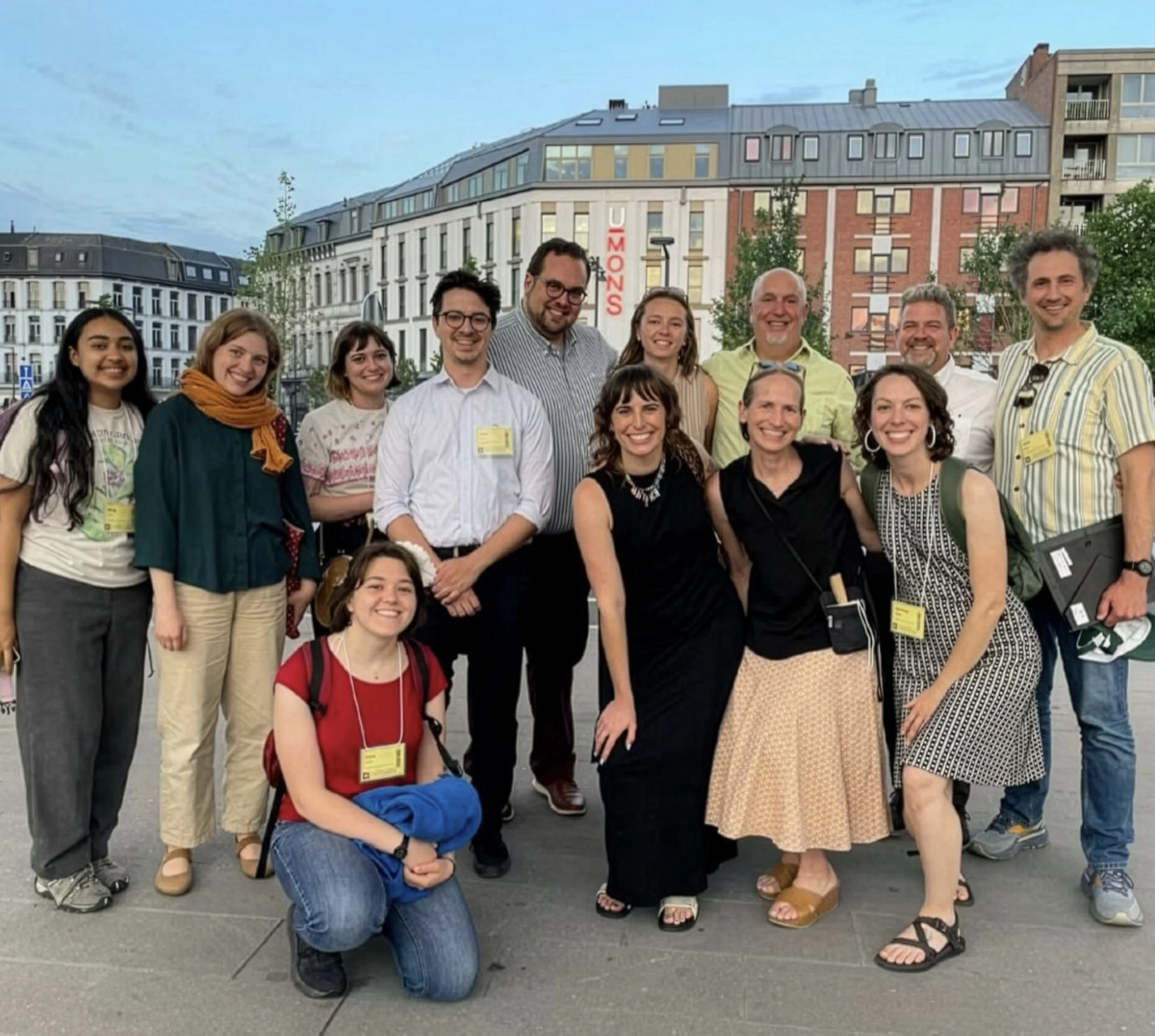
Neha Panda ’26, far left, at the XXVI International Conference of the Society for Human Ecology with (back row) Alexandra Löfgren ’25, Lily Besen-McNally ’20, Jake Totten ’19, Director of Career Development Jeffry Neuhouser, Andreigha Kraemer ’26, faculty members Jay Friedlander and Ken Hill, Director of Outdoor Programs Nick Jenei ’09, and (front row, from left) Lucy Dabbs ’25, Kira West MPhil ’18, and faculty members Ursula Hanson and Kourtney Collum
By Neha Panda ’26
An interdisciplinary group of College of the Atlantic students, staff, and faculty took part in the XXVI International Conference of the Society for Human Ecology (SHE) in Mons, Belgium during summer 2025. They shared projects and independent studies, and presented and attended talks on a diverse set of topics, from urban ecology and rewilding to human-ecological education, all falling under the conference theme of Ecology, Politics, and Justice: Working Towards the Pluriverse.
Attending the SHE conference as an undergraduate student alongside peers, staff, and faculty was an enriching experience both academically and personally. The conference, hosted by University of Mons and SHE President Mihnea Tănăsescu ’06, included opportunities for participants to explore and engage with the historic city of Mons, a recognised UNESCO World Heritage site.
Engaging with a global community of researchers, scholars, educators, and leaders, I expanded my understanding of the field of human ecology in a novel cultural context and location.
Conference sessions were held on a wide range of topics including political ecology, food systems and agroecology, environmental law and policy, Indigenous knowledge and practice, and much more. “Everyone at the conference seemed concerned about both the human and environmental impacts of every issue,” said Lucy Dabbs ’25, who was part of the student group attending the conference.
“Human ecologists are deep, out-of-the-box thinkers. Rather than working within existing structures, we are reimagining ways of transforming the system.”
As student attendees, we got to present our academic work at the conference in the form of short talks, posters, and Ignite-style presentations. I really enjoyed presenting my work alongside my peers at the conference, as COA students and recent graduates showcased their senior projects and independent studies in front of a larger community. It was wonderful to see leaders and scholars at various stages of their academic paths engage with each other’s research, and it made me feel proud to see the inspiring work of COA students being appreciated and recognised.
One recurring theme was human-ecological education and how to talk about it with prospective students and their families. I interacted with leaders from programs and organizations from around the world over a roundtable discussion, exchanging ideas and talking about how our institutions could be in closer collaboration and partnership. There were also buzzing conversations and opportunities to connect over coffee breaks and lunch periods each day.
The conference led me to appreciate the many ways that human-ecological thinking is being applied and thought about around the world. It was really helpful as a student to feel the synergy as well as the different opinions presented in these discussions. These various perspectives gave new insights to my own education and that of my peers at COA, and we gained many interesting insights about our institutional values and philosophy by connecting with each other in a new setting.
In addition to being a great place for scholarly exchange, academic conferences are an excellent space for students to make connections for internships and learn about post-graduate opportunities. “SHE serves as a gateway for students to become aware of other institutions that are practicing human ecology, and it helps them see the true value of their degree program,” said COA Director of Academic and Administrative Services Lothar Holzke ’16, who helped organize the conference. “There’s a vital network of human-ecological programs around the globe that SHE allows us to connect with directly.”
The SHE conference gave me a way to present my work and passion for alternative education and self-directed pedagogy, and engage with academic scholars and systems thinking outside the COA classroom. I would encourage any student who is looking to expand their connections within the interdisciplinary field of human ecology to get involved, ask questions, and apply to present at upcoming SHE conferences! Learn more at societyforhumanecology.org.