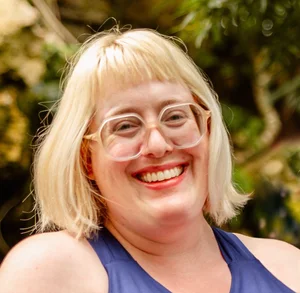
Ivy Enoch ’18
A sense of direction
By Anara Katz ’24
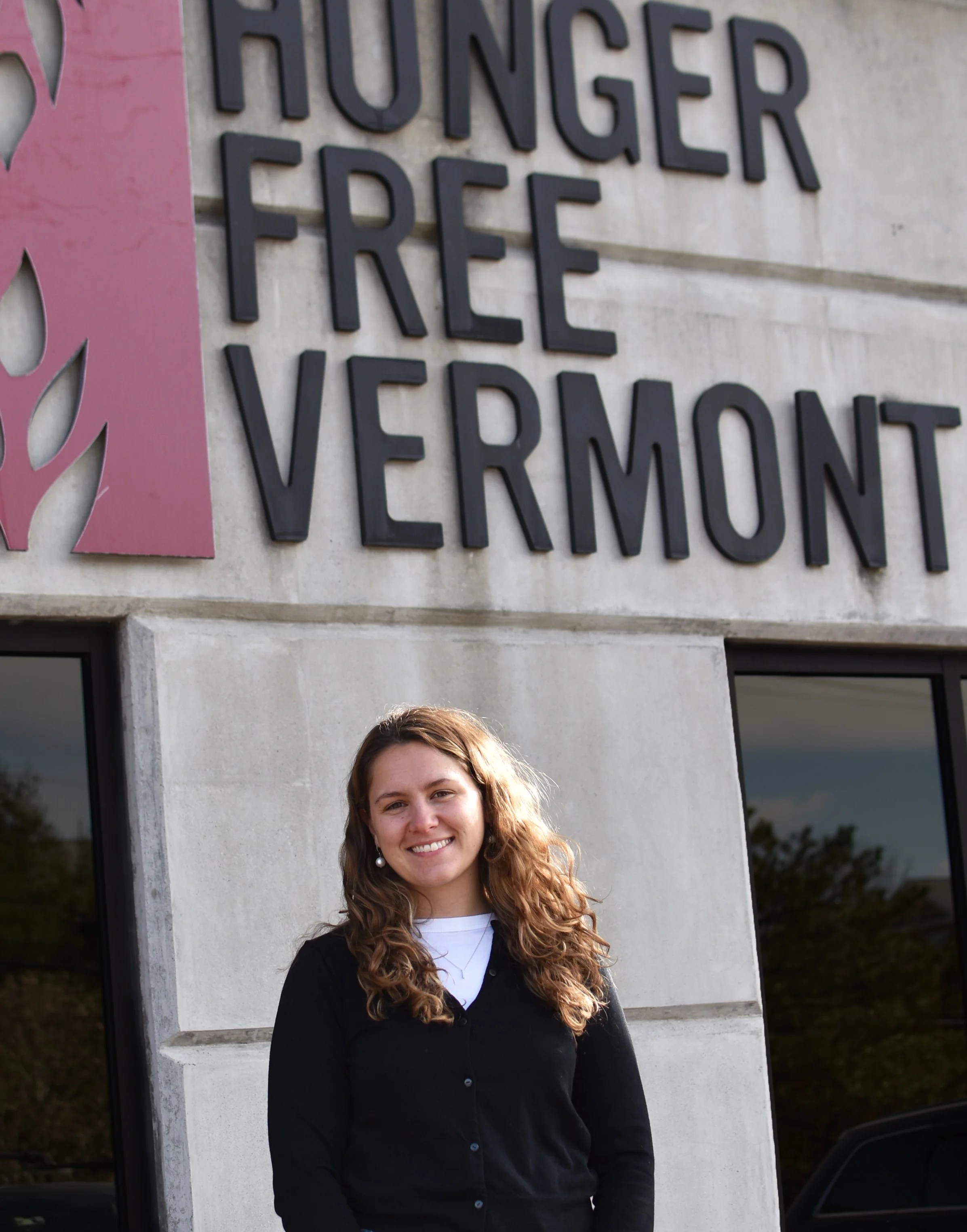
Hunger is solvable, asserts Ivy Enoch ’18, the director of policy and advocacy for Hunger Free Vermont, an organization aimed at eradicating food insecurity. Hunger is not due to a lack of resources, but rather a lack of political will to correct this injustice. “Hunger is a policy choice,” she explains.
Enoch wears many hats at Hunger Free Vermont, such as working on policy bills, collaborating with state and federal representatives, and training people on the ground who help connect programs with people who need them. She has been Vermont-based since 2020. Beyond working to end hunger, she spends time in nature mountain biking and gardening, and enjoys the company of her partner and two cats. This gives Enoch the work-life balance to carry on fighting for those who need help.
In Vermont, only 50% of eligible SNAP recipients are actually enrolled. “We do public outreach to destigmatize the experience of tapping into programs like SNAP, and why hunger exists in the first place. Many people move in and out of the experience of being food insecure. We help people recognize these programs are ours, we pay for them with tax dollars, and we need to tap into them from time to time,” Enoch expresses.
“Believing that hunger is a solvable issue,” explains Enoch, “takes form in a type of hope that is necessary for this line of work.”
“Hope is a muscle. Hope is this thing that we have to work, stretch, take care of, nurture, and challenge. Ending poverty is a long game. You have wins and then you have setbacks. The federal government shutting down, or not releasing benefits to people at the top of the month. It’s like a marathon, and you need strong muscles for a marathon. My strong muscles are hope,” she elaborates.
Enoch was standing in a field at COA’s organic produce farm, Beech Hill Farm, where she worked at the time, when she realized that, in order to work toward her vision for a just and thriving food system, she needed to step into the world of policy.
Like many COA students, Enoch’s studies encompassed a wide range of classes and disciplines. Her senior project focused on the story of her family’s farm in Oklahoma, which she never knew firsthand but heard about all throughout her childhood. The loss of this farm, a very impactful event for her family, tells a narrative reflecting the national shift in the 1980s of small family farms to industrial agriculture. “Bigger stories and policies have a very real impact on everyday people and their lives,” Enoch explains.
While Enoch’s academic path brought her to the relationship between people, policy, and land, she never lost her commitment to the wider philosophy at play. “At COA, when you meet someone new, many ask what your focus is. I would always tell them, I am focusing on human ecology.”
For Enoch, human ecology is an essential part of how she lives her life. It inspires her philosophy of active hope and making a positive impact in the world. “The tools that COA students develop and hone as human ecologists are so essential for the time that we’re in, the challenges we face, and what we need to solve, as people on this planet,” she remarks.
“I encourage folks to not shy away from the weirdness of human ecology. Not to push it aside by saying, Oh, it’s just this funky degree, but we actually focus on something else,” Enoch urges. “Come up with your own statement for what it means for you, how it gives you a sense of direction, and defines the principles in your life.”