Rick Epstein ’84
Broader perspectives
By Anara Katz ’24
For Rick Epstein ’84, human ecology means a life-long passion for learning. Throughout his accomplished architectural career, Epstein has continued to explore the unknown and say yes to unconventional ideas, projects, and adventures.
Epstein’s style of learning has always been hands-on. Before coming to COA in the late 1970s, he hiked much of the Appalachian Trail. During his time at COA, he took field ecology classes, and for his senior project, he designed a house that was then built by students and given to a low-income family.
After graduating, Epstein followed his worldly curiosity. Thanks to the Thomas J. Watson Fellowship, he traveled around the globe at 40 degrees north latitude for one year. This took him to Portugal, Spain, and Italy, from the former Yugoslavia to Greece and Turkey, and on to six months in China and Japan, learning about traditional homes and communities. After completing his Watson Fellowship, coming back with 10 full sketchbooks, many rolls of film, and new understandings, he went to MIT for a master’s degree in architecture.
“The breadth of human ecology has continued to resonate with my interests, and who I am. I like to think holistically, values-based, and more real world, tackling problems out there,” expressed Epstein. Epstein owns an architectural design firm, re:architecture, in Boulder, Colorado, where he works on a diversity of projects, including urban design, historical restoration, cultural centers, housing projects, interior renovation, and much more.
“I’ve worked in some design firms that want to put you in a narrow box. You’re an urban designer, not an architect, but I’ve been an architect for 20 years. Being able to move across disciplines and reference other kinds of disciplines is the value of an ecological perspective,” he explained.
Epstein views the breadth of the human ecology degree as a strength that shouldn’t be overlooked. Epstein advises COA students to “not be afraid that it’s different. It can be a kind of secret sauce. I’m NOT doing a narrow thing, I’m doing a broad thing, thinking about a broader perspective. That can actually be a strength.”
Epstein’s firm is congruent with his human-ecological foundation. In addition to its broad scope, it is rooted in Epstein’s ethics and driven by a vision for a world filled with sustainable, affordable, and beautiful design. “It’s not about how much money I can make, but it is more about how I can make a great place or serve people,” he said.
If you ask Epstein about his projects, he will enthusiastically explain to you all the new things he is learning about, and the interesting people he has met along the way. One of his newest ventures has been designing a Latin night club in Denver, Colorado. He has enjoyed learning more about EDM, reggaeton music, and club culture. In addition to designing the four bars and a stage, Epstein designed the furniture, and helped to pick out the artwork, lighting, glassware, uniforms, and even created a few drinks with the bar owner. XSO opened in the fall and is slowly gaining a reputation as the nicest new club in Denver.
Another project he is currently working on is a 140-year-old gravity mine that is on the National Historic Register. He is designing a historically appropriate building to house a peat moss process that will cleanse the water from the mine’s heavy metals. The list of his interesting and diverse projects goes on, all pointing towards his unceasing curiosity to learn and expand his expertise.
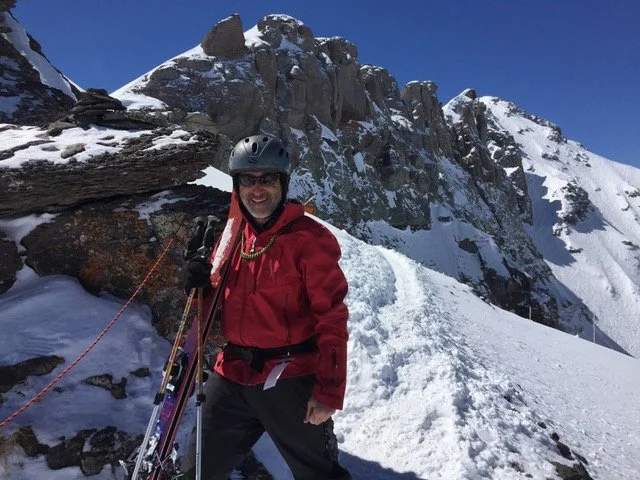
His adventurous nature continues outside his work. He is an avid cyclist, hiker, and backcountry skier. With his wife, an immigration lawyer specializing in political asylum, he raised two sons, who are now continuing to bring the innovative mindset into their own fields of AI, creativity, and urban planning.
“You become a lifelong human ecologist at COA,” he reported. Epstein shows us that his version of human ecology means taking life at large, and not being afraid to step into something new. His natural inclination to make connections across different knowledge bases and to be open-minded is exemplary of human ecology. He is excited to continue his adventures in architecture and beyond.