
Field guide to John G.T. Anderson
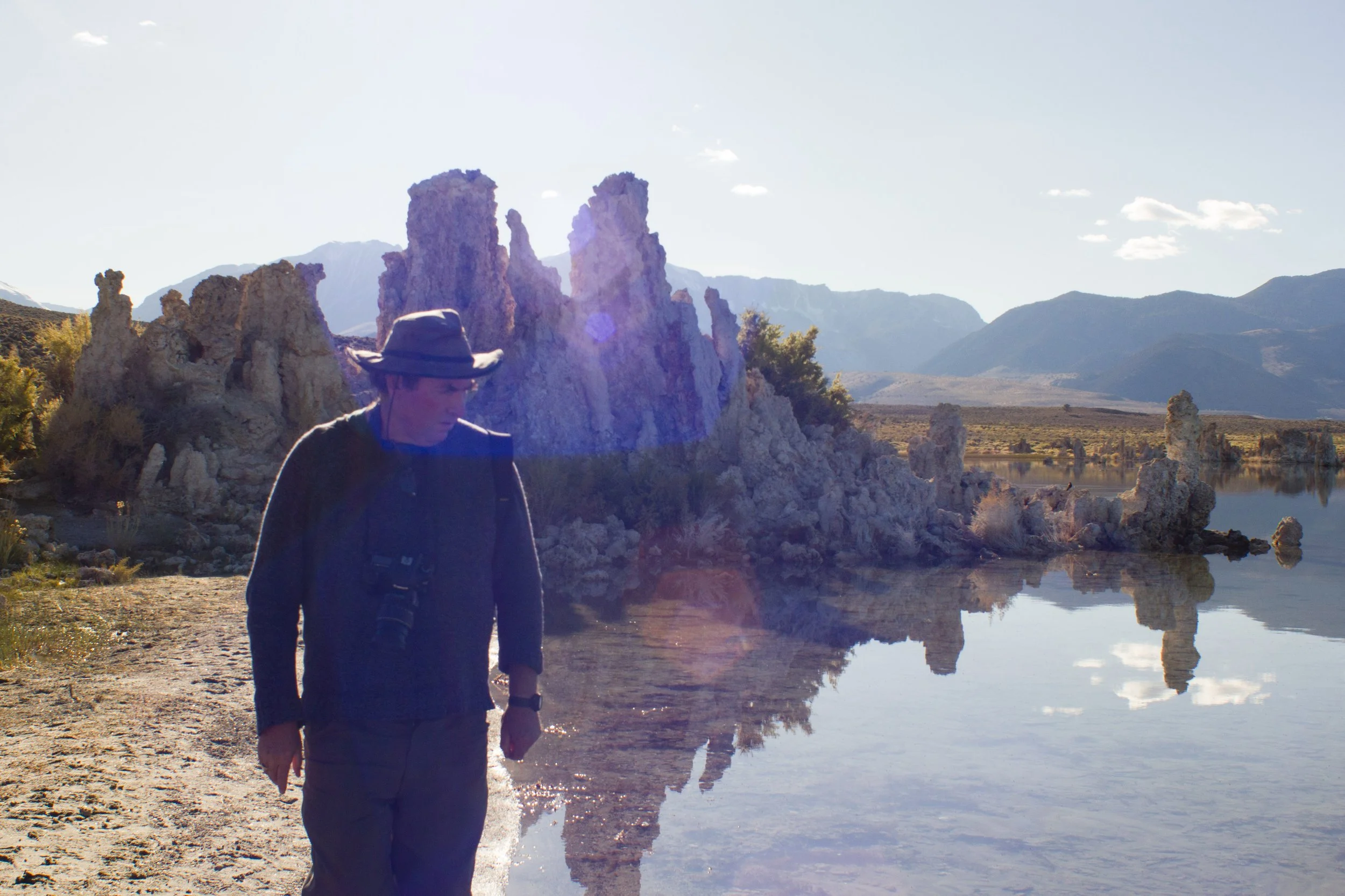
John at Mono Lake, Great West course, 2017
For nearly four decades, Homo professoris andersoni, John G.T. Anderson, has guided students to step outside and pay attention. It is documented that John taught 238 classes and tutorials, consisting of 51 different titles during his time at College of the Atlantic, his primary habitat for the majority of his life. In acknowledgement of John’s retirement in June 2026, this collection gathers the observations and reflections of some former students who were greatly influenced by this rare subspecies. Together, these observations sketch the outline of a career defined not just by an incredible depth of knowledge, but also by the generosity with which it was shared. Field guides help readers recognize key features and traits of a subject. This one is offered in gratitude for all John helped us recognize—in the natural world and in ourselves.
Identification
Distinguished by prominently developed supraorbital features, often described as “untamed eyebrows of considerable reach.”
Head tilt, arms out, and beaming smile for familiars
Frequently accompanied by a loyal quadrupedal companion, indicative of strong interspecific associations.
Locomotion characterized by a deliberate, ground-covering gait, typically with optical equipment (binoculars) suspended at the sternum, signaling preparedness for opportunistic field observation.
Seasonal change in coat from wool sweater and corduroys, to tacky tee and corduroys.
Frequently accompanied by emerging adults; those who have traveled to Great Duck Island, colloquially known as “Ducklings” (see range/migration).
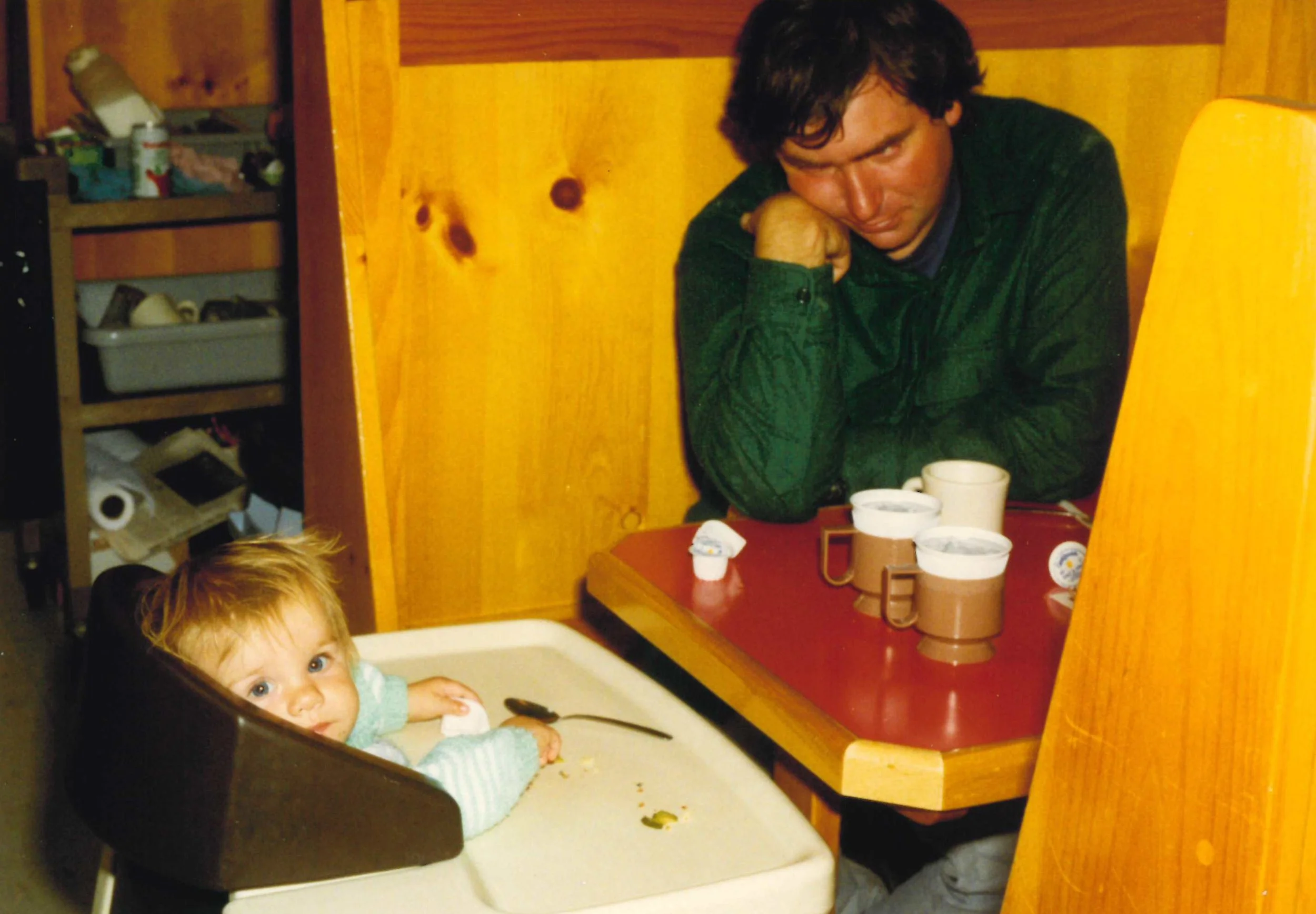
John and daughter Clare at Jordan’s Restaurant, 1991
Songs and calls
“So, what’s the gossip?”
“Sigh.”
“Hee hee hee!” (high pitched call, delighted or mischievous expression of glee)
“Oh dear!”
Frequent quotations from poetry, music, film, and famous literature ranging from Yeats to Alice in Wonderland to the Bible and many works in between.
Habitat
Deciduous and mixed forests, coastline, offshore islands (see range/migration).
Academic environments; specifically, small rural coastal College of the Atlantic since August 1987.
Pastry shops with abundant “tasty treats.”
Boats, transiently.
Islands, in and out of time.
Dusty, musty offices overfull with books, nautical charts, medical gadgets, and—invariably—artwork of a pelican and other sea birds.
Range/migration (adult)
Fall, winter, spring: regularly found in coastal Maine.
Fall, winter, spring: Sporadic transient visitor to all corners of the globe on short vacations or longer “sabbaticals,” with emphasis in cities where ornithology or human ecology conferences are held, massive ancient libraries are housed, and former students have settled.
Summer (June–July): Petit Manan Island (1989–1998) and Great Duck Island (1999 –present) off the coast of Maine, where he has led field research monitoring bird populations and mentored student research. Rugged, exposed, windswept environment with rustic facilities.
Periodic fall circuit (August–October): In recent decades, a regular biennial trip into the Western US with collegiate professor and van full of emerging adults for approximately eight weeks to study ecology, natural history, and land policy of the region. This is thought to be a transfer of acquired species knowledge.
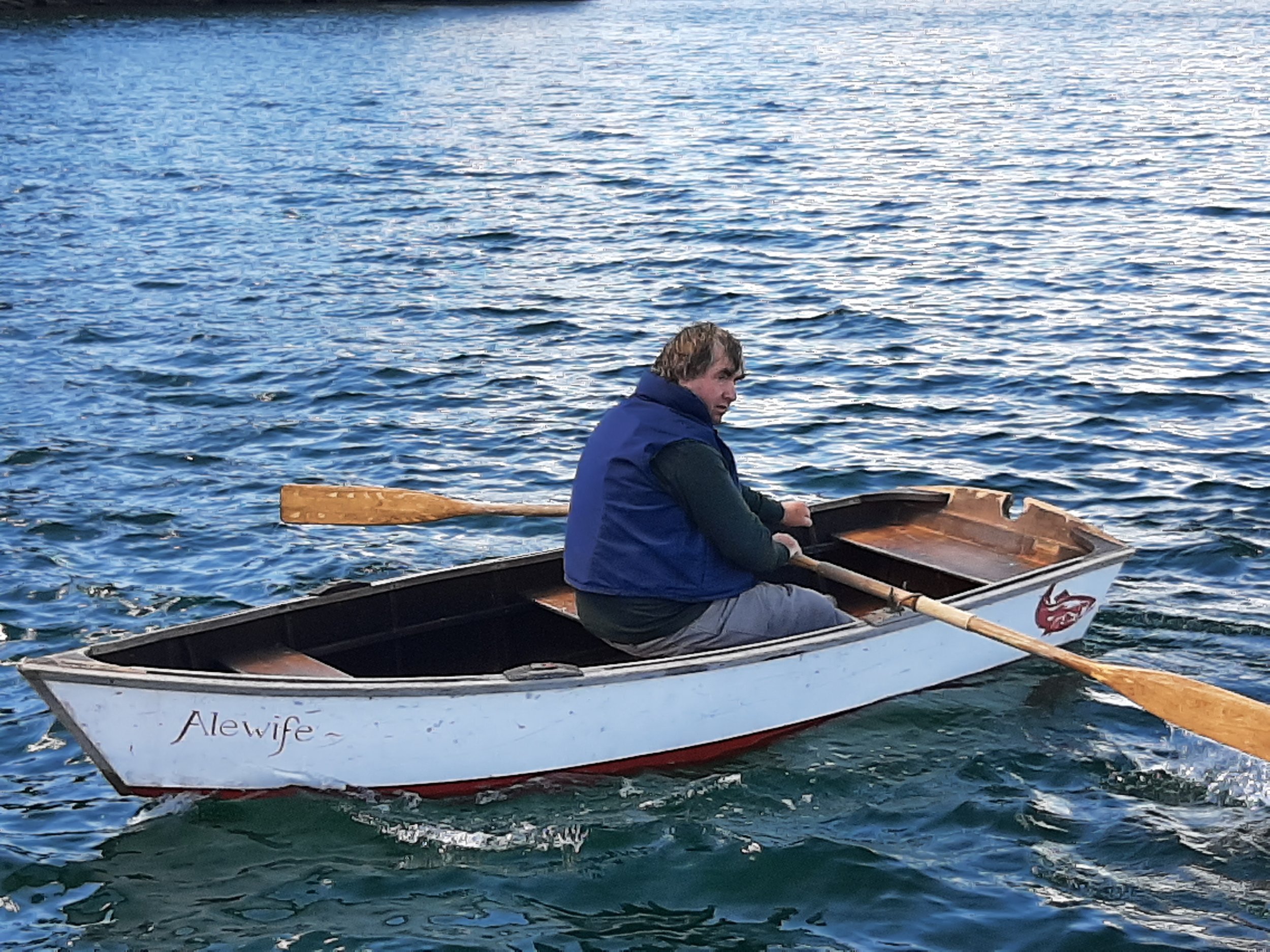
John rowing Alewife at the COA waterfront
Behavior
Nesting: Mated for life with his highly intelligent and tolerant wife, Karen, whose steady presence sustains him and allows him to devote far too much time to his students (editors’ note: we are so grateful!).
Young: Brilliant, beautiful, and kind, two offspring inherited the best traits of Karen and John. Parenting of Clare and David gained extra depth from his many years teaching and mentoring COA students on the cusp of adulthood. John has developed the odd behavior of fostering Ducklings and other former students who often return to visit after they have officially fledged.
Roosting: Periodically hunkers down to craft manuscripts for scientific journals, conferences, or full-length books.
Feeding behavior/diet
Strong coffee, burnt sausage, waffles, and bacon in the morning when hosting old alumni from out of town.
Lunch at Jordan’s or China Joy while discussing poetry of the sea with colleagues, students, and friends.
Tea and scones at his kitchen table at 4 p.m., with freshly whipped cream.
A variety of dinner provisions for carnivores (grilled meat) and herbivores (grilled fake meat) alike, paired with a bountiful salad of greenery; warm, filling meals suitable for crowds and accommodating dietary restrictions.
In maturation, has taken to becoming a bit of a wine and cider connoisseur, but also known to down a few too many mudslides back in the day.
Dessert is appreciated and Pavlova is welcome (but only if it’s a traditional recipe).
Glass o’ milk or cup o’ cocoa before nesting down for the night.
His foraging strategy is opportunistic but always social; meals are less about nutritional sustenance than about intellectual exchange.
Deathly (emotionally) allergic to kale.
Social behavior
John Anderson is not a hugger.
Demonstrates an uncommon commitment to “office hours,” in which he meets with emerging adults who had to outcompete their peers to claim a spot before the sign-up sheet was filled. May take place in his office, at a bakery, or on a walk with his trusty canine.
In addition to advising current students, he maintains strong emotional connections to those who have fledged, nurturing changing relationships throughout their lifespans.
Leads and guides groups of emerging adults in the classroom and in the outdoor environment of Acadia National Park.
Instruction includes a wide range of courses, including standards such as Ecology, Conservation Biology, Anatomy and Physiology, Biology II, History of Natural History, as well as a willingness to take on new courses and group studies on extremely wide-ranging topics from Epic Poems to Earth’s Moon to Plagues, Panic & Prevention.
Team-teaches courses on interdisciplinary topics, such as Turn of the Century, The Great West, Environmental Literature, Literature and Ecology of the Sea, and Farming the Wild.
Co-teaches Islands Through Time, a course that has led many juveniles to enroll in COA.
Specialized behaviors
Even for a professor of human ecology (an interdisciplinary major), John is uncommonly well versed and interested in many areas of study. His interests—and the interests and future careers of his students—include history, literature, policy, medicine, psychology, and art.
Major themes in his pedagogy include the importance of critical thinking and evaluation of scientific works; the role of aesthetics and human preferences in determining conservation priorities; and the need to study history and do thorough, accurate research before arriving at conclusions.
Characteristics of his field ecology work, inspired by mentor Bill Drury and others, include rigorous observation of populations to study how they change over time.
Approach to “advising” students is difficult to capture in words, as it is so heartfelt, and it is here where his impact reverberates deep into his students’ lives. Not all subspecies of H. professori have such a strong, deep sense of obligation to not only the academic success of students but also to their professional satisfaction, personal growth, and happiness.
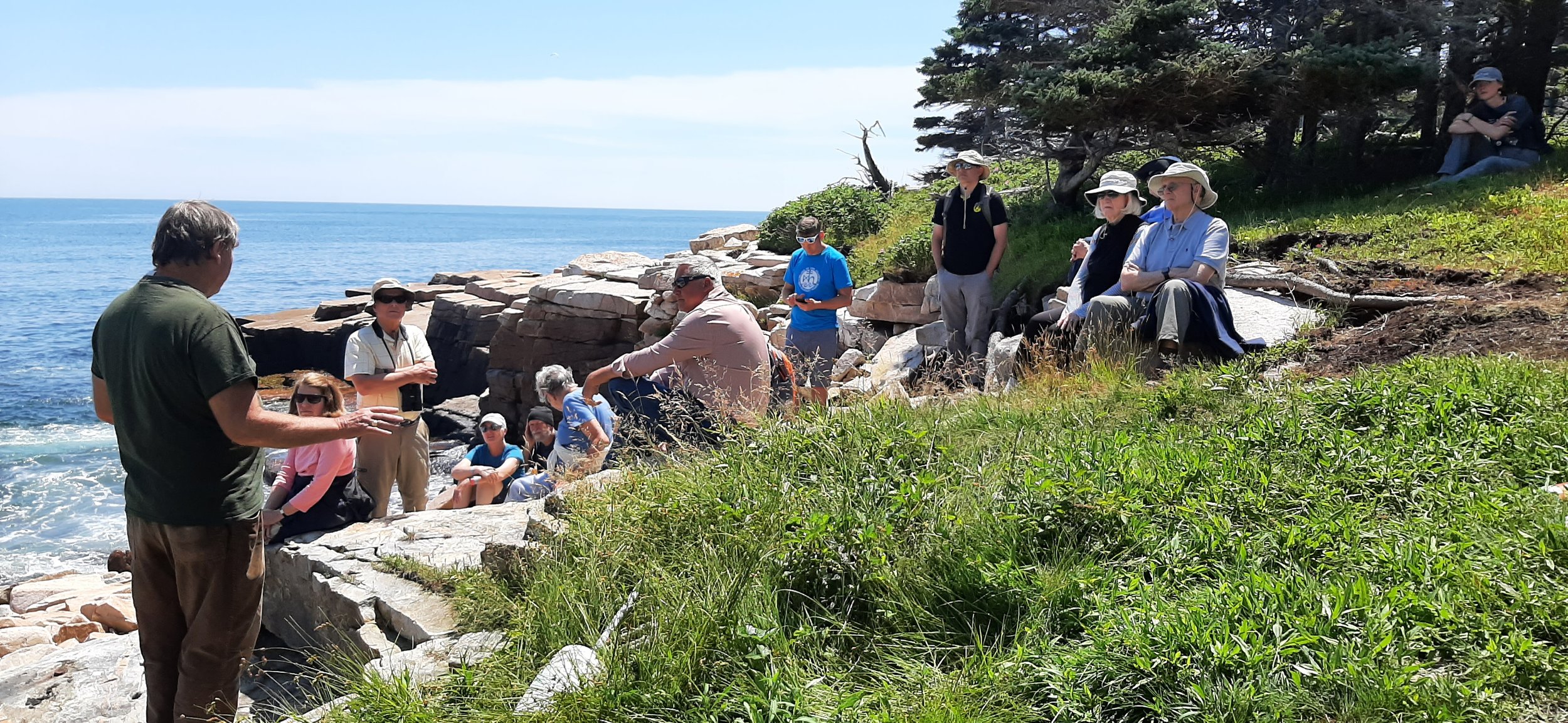
John and summer visitors on Great Duck
Conservation status: rare/threatened
This type of special creature is not common! During his time at COA, this dedicated and tireless individual advised more students than any faculty member in the history of the college. Over and over, his former students and advisees have commented on John’s interest in their lives, commitment to spending time with them, and dedication to staying in touch, regardless of their life’s course or career direction. His niche at COA—which may not be defined by an Nth dimensional hypervolume or any theoretical formula, for that matter—will be hard, if not impossible, to fill. John is a rare type worthy of conservation efforts.
Conservation recommendations
Though subspecies andersoni’s teaching style may be on the path to extinction, the authors encourage the college to take the following steps for the protection of other subspecies of H. professori on the Maine coast.
Habitat: Investment in island program infrastructure and continuance of the programs described above.
Recruitment: Commitment to filling the W.H. Drury Chair with a subspecies embodying field ecology and place-based, experiential learning.
Human ecology: The learning and connection that happens when students and professors together navigate a boat ramp, drive across the country, clean outhouses, and wash dishes both complement and eclipse the impacts of indoor instruction.
These steps and others will ensure that emerging adults can continue to acquire important species knowledge, conserving what makes COA, MDI, Great Duck Island, and other outdoor classrooms such special habitats.
Authors’ note
The authors of this field guide will not miss John after his retirement from COA in June 2026 because we are so fortunate to call him a friend. Plus, we know where he lives. The authors do, however, lament the fact that future students will never know the rare privilege of learning from someone who not only taught inspiring courses, but also lived and breathed his own study, passing it on with genuine devotion. John is taking with him a deep well of knowledge, his contagious passion, and a daily brilliance that shaped generations of students. This piece is our small attempt to capture what cannot truly be replaced.
Contributions from a dozen of John’s former students and advisees, ranging from the classes of 1993–2026. Sarah McDaniel ’93; Kate Devlin ’93; Nicole Cabana ’99; Cerissa Desrosiers ’00; Amanda Spector ’08; Kate Shlepr ’13; Ivy Enoch ’18; Gemma Lei ’18; Eleanor Gnam ’23; Autumn Pauly ’26.