Mihnea Tănăsescu ’06
Context, history, and locality
By Anara Katz ’24
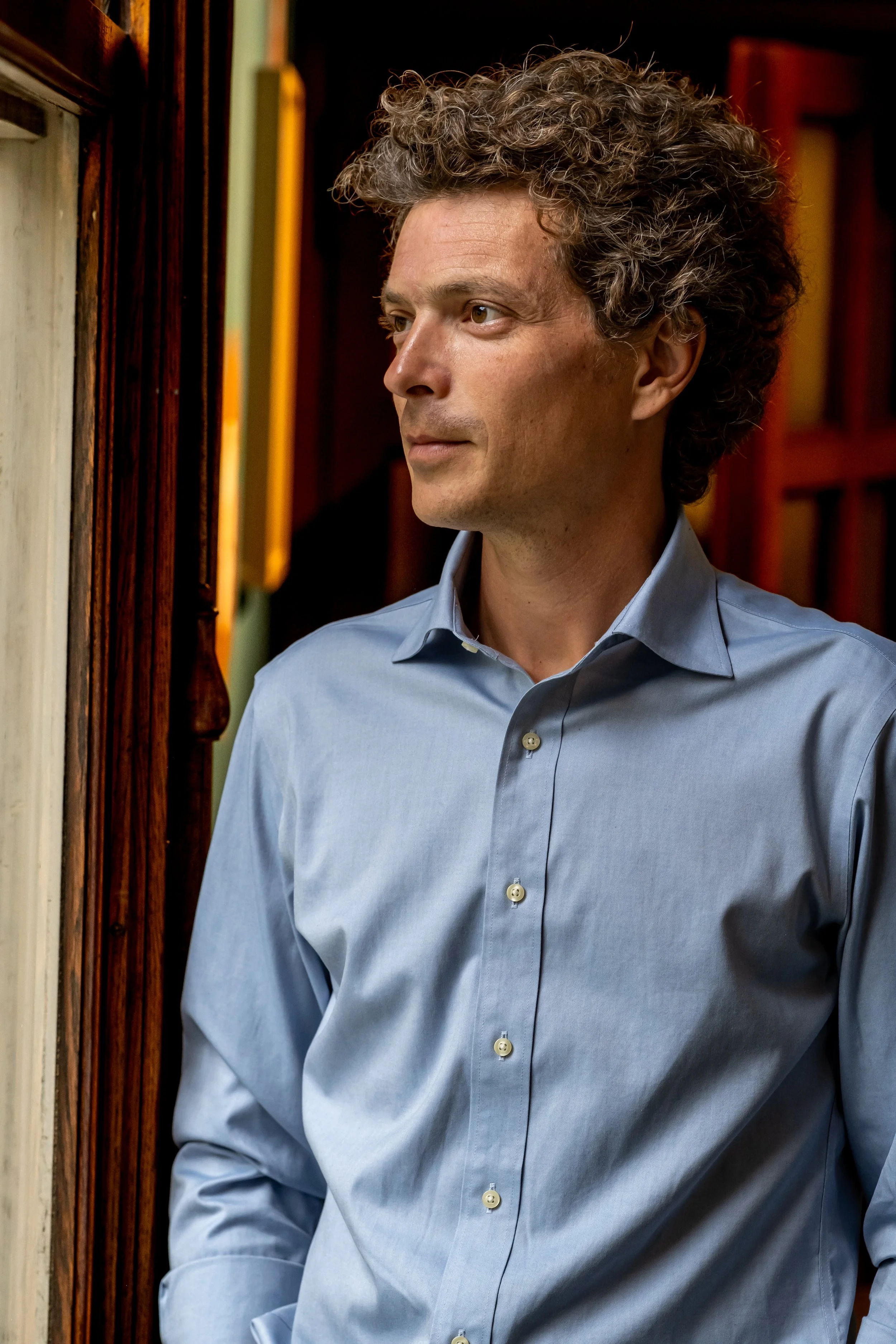
In a world filled with polarized politics and one-sided arguments, our opinions often inform our observations. Mihnea Tănăsescu ’06, professor and research fellow at University of Mons, Belgium, embraces uncertainty and ignorance as crucial to better understanding the interactions between humans and their multiple environments. A passionate philosopher, detail-oriented thinker, and human-ecologically rooted academic, Tănăsescu strives for specific, thoughtful, and empirically-based meaning in a complicated world.
“Ideas, prone as they are to becoming static, are never going to offer a faithful picture of the world, partly because what they are striving to immortalize is always one step ahead.”
Tănăsescu, while stating that labels do not matter much to him, exemplifies human-ecological work at its finest, embodying an expansive perspective that is open to considering all disciplines and possible connections.
His book, Ecocene Politics (Open Book Publishers, 2022), considers approaching socio-political studies using the lens of an ecologist. The book’s foundation was laid over a decade ago, when Tănăsescu encountered Chance and Change (University of California Press, 1998), a guide to ecological research, written by former COA professor Bill Drury and edited by COA W.H. Drury Professor of Ecology/Natural History John Anderson.
“Drury’s book really spoke to me in its attention to the specific. It doesn’t think of an idealized nature. It’s pragmatic and empirically grounded. Natural history has been a part of philosophy for me in many different ways,” Tănăsescu said.
Drury outlines three principles that ecologists must account for: chance, change, and locality, as every unique ecological system is subjected to constant, often unpredictable, change. However, sociology, economics, and political thought often miss the perpetual chance and change that the world will inevitably throw its way.
Writing Ecocene Politics was a “deeply personal process of trying to capture what I had come to learn through 10 years of work,” Tănăsescu said. This was a very different experience from writing another book he published in the exact same year, Understanding the Rights of Nature: A Critical Introduction (Transcript Publishing, 2022), which he wrote because “it had to be made.” In this book, Tănăsescu reminds readers that rights are not all good or bad, but rather must be theorized on a case-by-case basis, emphasizing the importance of thinking critically about context, history, and locality. Tănăsescu has worked hard to ensure his books remain open access and are freely available online.
Tănăsescu first fell in love with philosophy in high school, at United World College of the Adriatic in Italy. When he got to College of the Atlantic, he happily encountered COA’s rigorous philosophy classes, with professors like John Visvader and Rich Borden, reading primary texts from prominent philosophers and engaging in seminar discussions. Tănăsescu went on to receive a master’s degree in philosophy at the New School for Social Research in New York, and a PhD in political science at the Vrije Universiteit in Brussels, Belgium.
“The quality of the COA education really became clear to me when I went to grad school, because they weren’t that different from each other. The primary text authors I used to read at COA became my professors in New York. I never felt dumber than in that place, but in a very good way. And yet, in terms of what we actually did in class, it was more or less like COA,” Tănăsescu recounted.
Currently, Tănăsescu is a professor in the Department of Sociology and Anthropology at the University of Mons, Belgium, where he teaches a master’s course in human ecology. He was a visiting fellow at the New School for Social Research, NY, and the University of Auckland, Aotearoa, New Zealand. He has spent his career studying the political, emotional, and social relationship between humans and nature. His most recent research has brought him to thousand-year-old olive groves in Apulia, Italy.
“About a decade ago, thousands and thousands of trees started drying up and dying after, sometimes, millenia of existence. The oldest olive trees in Apulia are 3,000 years old, and most of them are now dry. What do people do when something like that disappears? How do you think, feel, and act through that? It’s an interesting case to look at the political decisions,” Tănăsescu said. “And, to look at it from the non-human perspective, the olive trees, the insects, the soil, and the bacteria as serious agents in a much wider play of culture and political forces.”