Melissa Ferrari: Art and inquiry
By Jeremy Powers ’24
In a studio filled with pencils, light table, and the faint whir of a projector, Melissa Ferrari speaks about art as inquiry, not spectacle. As the new professor of interdisciplinary arts at College of the Atlantic, Ferrari hopes to highlight the importance of open-minded learning to create art that transcends conceptual and physical boundaries.
“I have often appreciated classroom spaces that feel like a living arts studio where the teachers and students are all sharing ideas, rather than a flattened didactic space where the teacher is simply telling,” she says. “I hope to foster a classroom where it feels like we are all learning together, and where education can be a catalyst to forming a creative community.”
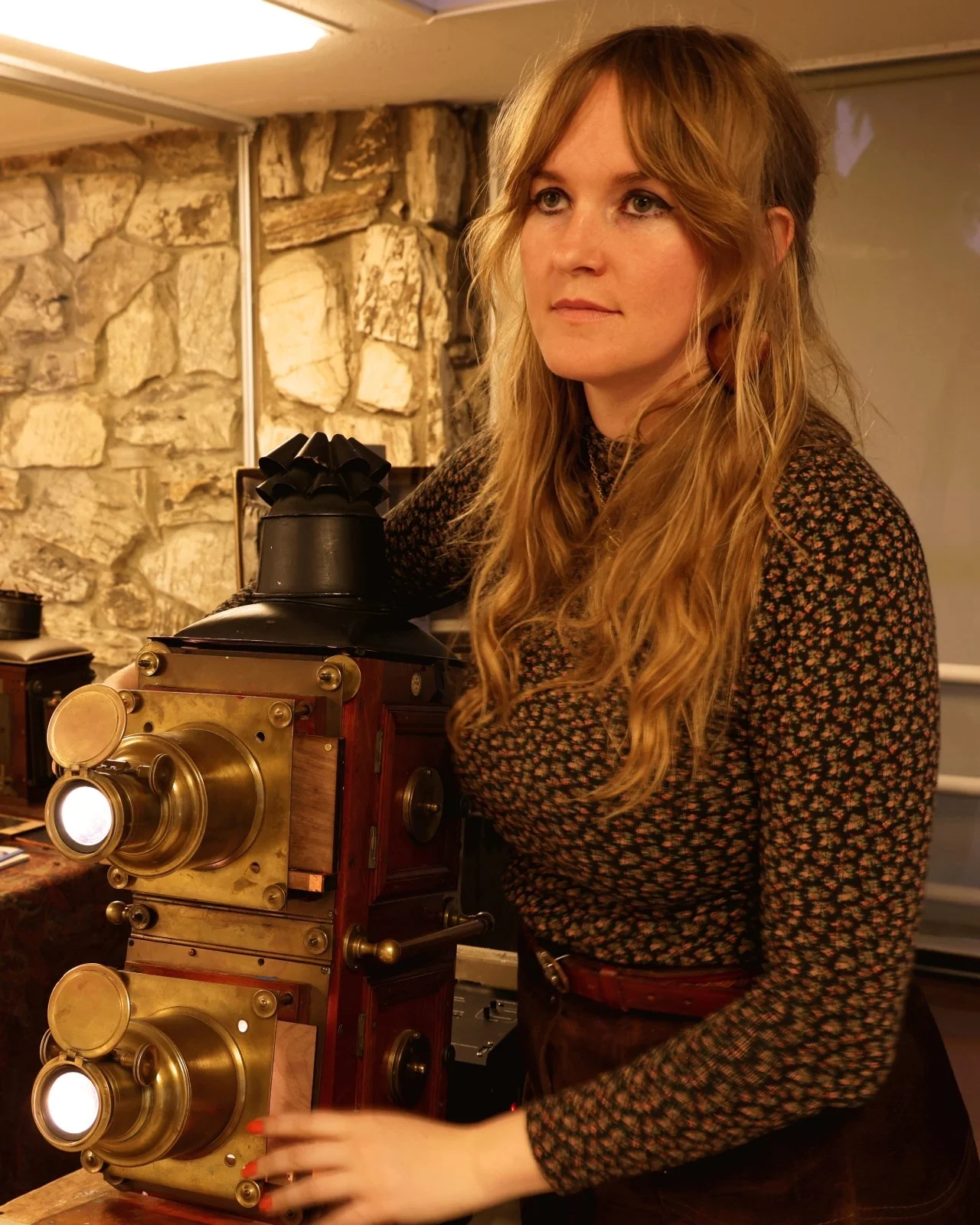
As an undergraduate at Tufts University, she studied animation and philosophy, an early pairing that continues to shape her thinking. After working at an animation studio in New York, she earned a Master of Fine Arts in Experimental Animation from the California Institute of the Arts and went on to build a freelance career in Los Angeles, creating hand-drawn animated sequences for documentary films. Along the way, she began performing with antique 19th-century magic lanterns—early slide projectors that once dazzled audiences with moving light—traveling to festivals and museums to revive the medium.
“My background in experimental animation motivates me to teach animation as a form of art, and a vessel for conceptual ideas, rather than just a traditional mode of entertainment and storytelling.” Her work often engages science, mythology and history, exploring “epistemological themes of belief, evidence, and veracity.” Ferrari sees animation as uniquely capable of navigating difficult terrain: “It is an emotionally resonant, powerful tool for engaging social issues and reckoning with urgent, complex, and vulnerable topics.”
Ferrari says she was drawn to COA by its commitment to interdisciplinary study. “Hearing about the research being done by other members of the COA community is thrilling,” she said. She envisions collaborations that might include animated scientific visualizations, public service announcements on environmental justice, or films for the Dorr Museum. In her classes, students versed in physics and zoology analyze how creatures move with anatomical precision, while others steeped in philosophy and anthropology connect animation to theories of cosmology and power. “It’s really a beautiful thing to experience and witness as a teacher,” she said. “It creates a fantastically interdisciplinary conversation in the classroom.”
Looking ahead, Ferrari plans to teach courses in animated and live-action documentary and to develop practicums that connect students with research and activism on campus and in the surrounding community. She is also imagining an expanded cinema course that would incorporate projection mapping, using the island’s granite cliffs and historic architecture as canvases for light.
“Just grateful to be a part of COA,” she said. “Especially in these dystopian times, I’m so thankful to be a part of a community that allows honest conversations and thoughtful engagement with how to support our global community.”